
How fabric affects acoustics: the interior designer's guide to sound absorption and transmission
- May 4th, 2026
-
 Fabrics Education
-
 All Spaces
There's a reason a fully furnished room feels different to an empty one. Why is this? It could be because of the sound.
The moment you introduce curtains, upholstered panels, and soft seating, the acoustics shift. The space gets quieter: the kind of environment people actually want to spend time in.
For professionals specifying interiors, understanding how fabric influences sound is one of the more underrated tools in the toolkit. Plus, the acoustic needs of a space are very site-specific. A hotel lobby has different acoustic needs than a busy open-plan office, for example.
The short version
- Fabric does two distinct acoustic jobs: absorbing sound within a space, and blocking it from passing through (aka sound transmission)
- Sound absorption is rated A–E (αw class); most commercial interiors need Class C or D
- Sound transmission is rated by Rw/STC; a rating above 10 reduces perceived noise by around 50%
- Published test results are based on a single flat layer. Real-life installations with layering and fullness perform better
- The more fabric in a space, the softer it will sound, and the better the ambiance.
Sound absorption vs sound transmission
Fabric can either absorb sound within a space or block it from travelling through — and these are different properties, tested differently, and require different materials.
What is sound absorption?
Sound absorption is about what happens within a space.
How does it work?
When sound waves hit a surface, some of that energy is taken in rather than reflected back into the room. The result is either increasing or reducing echo and reverberation: it depends on the material. Upholstered wall panels are the classic application here, but curtains, drapery, and upholstered furniture all play a role too.
What is sound transmission?
Sound transmission is about preventing sound from passing through a material from one space to another. This could be, for example, through a partition wall, across a room divider, or in through a window. Dense, solid materials are most effective here; lightweight decorative fabrics, not so much.
How are fabrics tested for acoustics?
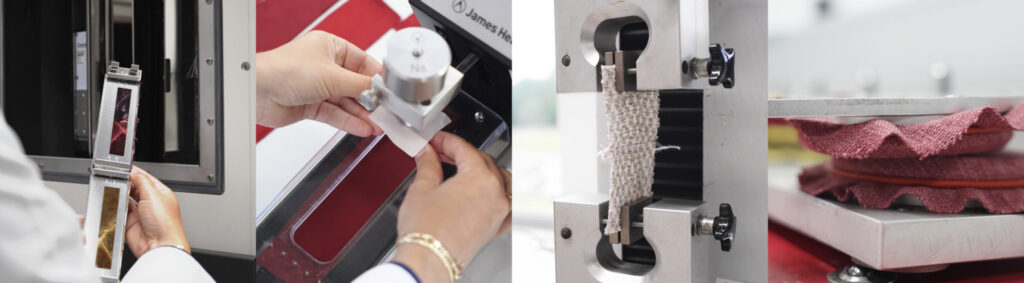
A specific acoustic performance test is carried out through what's called the impedance tube test. This test measures sound absorption using the ISO 10534-2 standard. This is now the preferred method over older reverberation room testing, which wasn't sensitive enough for fabric-level assessment.
👉 Get the full testing information on our Upholstery 101 guide.
What the acoustic ratings actually mean
Sound absorption: αw and class ratings
The Weighted Sound Absorption Coefficient (αw), tested to ISO 11654, is the standard measure of how well a fabric absorbs sound. Values run from 0 (no absorption) to 1 (total absorption), translating into class ratings from A (highest) to E.
For most interior applications, Class A isn't necessary. Here's a practical breakdown:
Space | Recommended minimum | Why |
Hotel rooms / residential | Class D | Comfort and sleep quality |
Offices / meeting rooms | Class C | Balance between absorption and liveliness |
Restaurants and cafés | Class C | Background noise reduction |
Corridors / hospitals | Class D | Basic noise control |
Cinemas / theatres | Class B | Reducing echo, improving clarity |
Recording studios | Class A | Precise acoustic control |
If you're working to ASTM standards rather than ISO, the equivalent metrics are the Sound Absorption Average (SAA) and Noise Reduction Coefficient (NRC). Both are measured on a 0–1 scale with the same logic: higher is better.
Sound transmission: Rw and STC
The Weighted Sound Reduction Index (Rw), tested to ISO 717-1, measures how many decibels of sound a fabric blocks. A rating above 10 means perceived noise is reduced by around 50%. The ASTM equivalent is the Sound Transmission Class (STC).
The thicker the material, the better the sound absorption. Opting for performance fabrics in heavier weights is a straightforward way to achieve your acoustic goals. This is even more so if you specify upholstery fabrics like velvets, chenilles and textured bouclés, creating a sense of comfort and luxury.

How layering fabrics impacts acoustics
Published acoustic test results are based on a single flat layer of fabric. Real-world installations with added fullness, liners, and air gaps consistently outperform laboratory benchmarks.
The best way to use drapery fabrics for acoustic impact:
- a sound-absorbing face fabric
- an optional absorbing liner (fleece or batting)
- a denser sound-reducing backing.
The air gap between the curtain and the wall or window adds further performance. Ideally it should be 90 to 110mm.
An acoustic wall panel has pretty much the same construction idea:
- a face fabric
- a layer of sound-absorbing foam
- a small air gap (20–50mm)
- a sound-reducing backing.
The result is a construction that both softens sound within the space and limits what passes through. When it comes to specification, fabric selection and installation are both part of the acoustic equation.
Performance fabrics as acoustical tools: a powerful combination
The bigger picture
Acoustic specification sheets generally focus in on ceiling tiles, hard partitions, and dedicated acoustic products, but furniture and drapery plays a bigger role than you might think.
Upholstered wall panels, full-height drapes, and densely woven seating upholstery all contribute meaningfully to how a space sounds. Unlike dedicated acoustic products, they're simultaneously doing four or five other jobs.
Fabric is one of the most versatile acoustic tools in the specifier's kit, when they’re specified with the right class ratings for the application.
As performance fabric specialists, our role is to make sure that your interior specification choices are also your most useful ones. That's a good return on a fabric choice.
FAQ: acoustic performance
Q: What fabric properties improve acoustics the most?
Weight, density, and texture all play a role.
Heavier, thicker fabrics absorb and block more sound than lightweight sheers. Textured or looped surfaces create more surface area to intercept sound waves. Layering multiple fabric types gives the best combined performance, especially combining an absorbing face with a denser backing.
Q: What αw class do I need for a hotel room?
Class D is the recommended minimum for residential and hotel room applications, where the goal is enhanced comfort and sleep quality rather than precise acoustic control.
Q: What's the difference between NRC and αw?
Both measure sound absorption on a 0–1 scale, but they use different testing standards. NRC and SAA are ASTM measurements (ASTM C423); αw is an ISO measurement (ISO 11654). The underlying principle is the same: higher values mean more absorption.
Q: Do curtains actually improve acoustics?
Yes! Full length curtains absorb sound energy and reduce echo within a room. Their impact gets even greater when they leave that air gap (90 to 110mm) and heavier fabrics are used. Adding a dense blackout or thermal lining also helps block sound transmission. The effect is even greater when the space is fully furnished, especially with other soft furnishings like fabric sofas with cushions; poufs, etc.
 Design Inspiration
 Hospitality