
Welcome to the ultimate upholstery fabric guide
Table of Contents
Not all performance fabrics are built the same.
What is the definition of sofa upholstery fabric?
Upholstery fabric is textile material used to cover and pad furniture, such as sofas, chairs, ottomans, and headboards. 'Upholstery' refers both to the finished covering on a piece of furniture and, more generally, to any fabric-covered soft furnishing.
The Building Blocks of An Upholstery Fabric
Upholstery fabrics can be understood through four layers: fibre, yarn, construction, and finish. The fibre is the raw material from which the yarn is made. Common natural fibres include cotton, linen, and wool, each offering different characteristics such as softness, texture, or durability. Synthetic fibres such as polyester, nylon, acrylic, and polypropylene are widely used in upholstery because they tend to be more durable, stain-resistant, and easier to maintain.
The fibres are spun into yarns, which are then formed into a fabric through a specific construction method. The most common upholstery fabrics are woven, meaning two sets of yarns are interlaced at right angles to create a stable and durable structure. Less common are knitted constructions, which use interlocking loops to create a softer, stretchier fabric, and non-wovens, where fibres are bonded together rather than woven or knitted.
Within woven fabrics, the weave type influences both appearance and performance. A plain weave uses a simple over-under pattern and is durable and versatile. A twill weave creates a diagonal pattern that offers a softer feel and tends to hide wear well. A satin weave produces a smoother, more luxurious surface, while a jacquard weave allows intricate patterns to be woven directly into the fabric.
Many upholstery fabrics also have distinctive surface constructions. For example, velvet features a cut pile that creates a soft, plush surface, chenille uses fuzzy yarns for a rich texture, bouclé is made from looped yarns that create a textured appearance, and flatweaves have no pile, giving them a cleaner and more tailored look.
Finally, fabrics often receive a finish to enhance performance, such as stain resistance, water repellency, anti-microbial protection, or improved durability. As a result, most upholstery fabrics can be described using a simple formula: fibre → yarn → construction/weave → finish. For example, a fabric might be 100% polyester, spun into chenille yarns, woven in a jacquard construction, and treated with a stain-resistant finish.
Weaves and Fibres
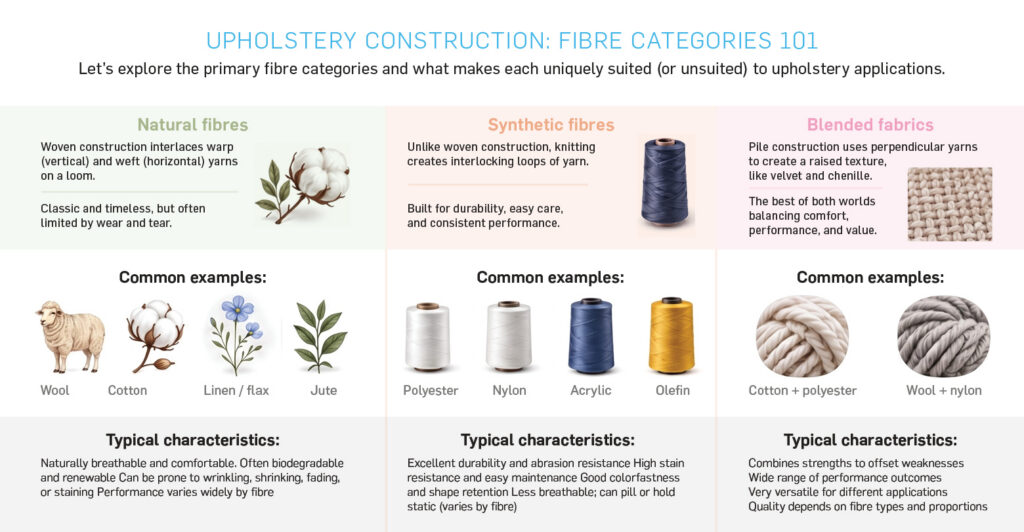
Let's explore the primary fibre categories and what makes each uniquely suited (or unsuited) to upholstery applications.
- Natural Fibres: Natural fibres come directly from plant or animal sources, each bringing distinct characteristics developed through millennia of evolution. Classic and timeless, but often limited by wear and tear.
- Synthetic Fibres: Manmade fibers. Modern, durable, and engineered for performance: How polyester fabric is made: from chemistry to finished fibre.
- Blended Fabrics: Many upholstery fabrics blend multiple fibre types to balance competing priorities. A cotton-polyester blend might offer cotton's softness with polyester's durability and stain resistance. Wool-nylon blends preserve wool's natural resilience while improving abrasion resistance in high-wear zones.
Upholstery Construction
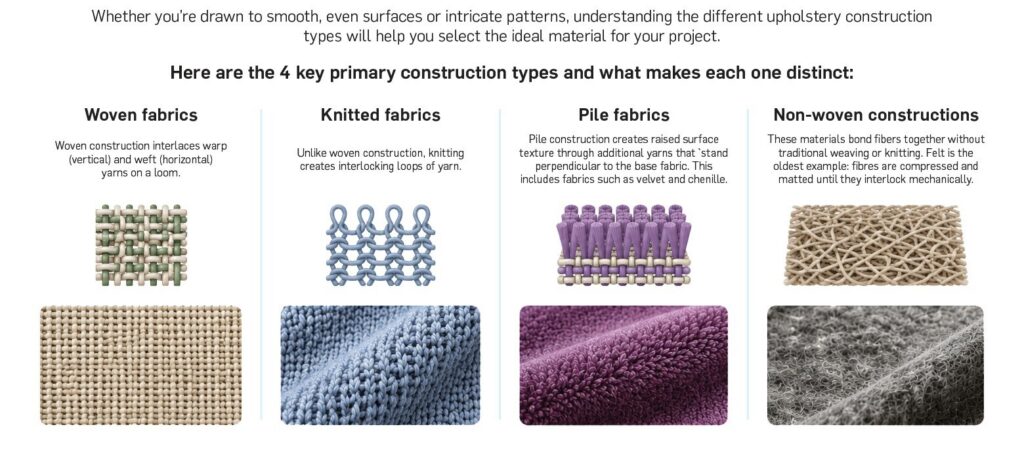
Whether you're drawn to smooth, even surfaces or intricate patterns, understanding the different upholstery construction types will help you select the ideal material for your project.
Here are the 4 key primary construction types and what makes each one distinct:
- Woven fabrics: Woven construction interlaces warp (vertical) and weft (horizontal) yarns on a loom.
- Knitted fabrics: Unlike woven construction, knitting creates interlocking loops of yarn.
- Pile fabrics: Pile construction creates raised surface texture through additional yarns that stand perpendicular to the base fabric. This includes fabrics such as velvet and chenille.
- Non-woven constructions: These materials bond fibres together without traditional weaving or knitting. Felt is the oldest example: fibres are compressed and matted until they interlock mechanically.
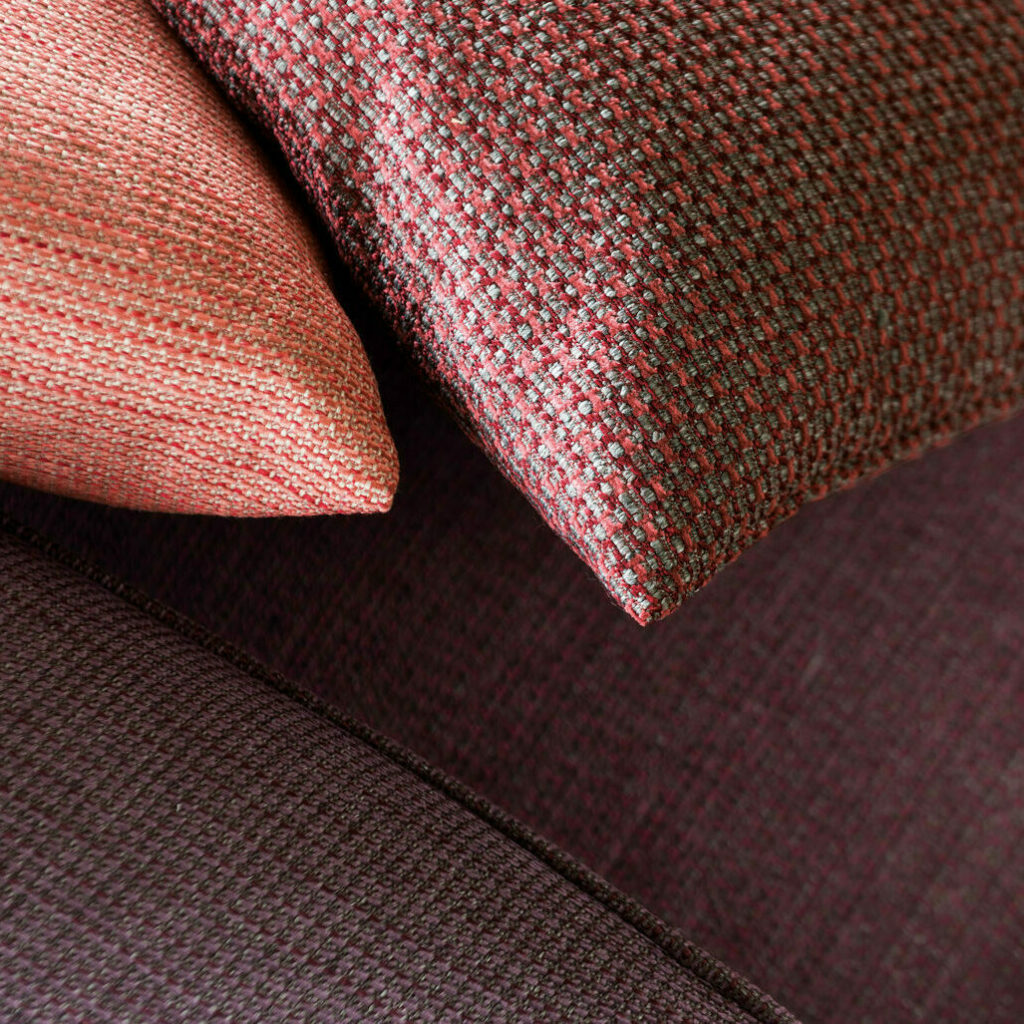
All About Sofa Fabrics and Performance Testing
The perfect formula for world class fabrics is based in engineering and textile science, through tracking proven performance metrics across a range of criteria.
These tests provide measurable data on how a fabric will behave over time under typical conditions such as friction, cleaning, and environmental exposure.
Performance Testing: Abrasion Resistance
Abrasion resistance assesses how well a fabric withstands repeated rubbing and wear. Common methods include the Wyzenbeek and Martindale tests, which simulate long-term use by applying controlled friction to the fabric surface.
Performance Testing: Pilling Resistance
Pilling occurs when loose fibres on the fabric surface tangle into small balls due to friction.
For full testing protocols and standards for both abrasion and pilling resistance, visit our Mechanical Textiles Tests page.
Performance Testing: Colour Fastness
Colour fastness measures a fabric’s ability to retain its colour when exposed to factors like light, rubbing, and cleaning.
Dive into the full testing protocols for the 5 colourfastness tests that secure FibreGuard fabrics’ optimal fade protection
Performance Testing: Stain Resistance and Cleanability
This process tests the fabric with different types of stains in various conditions, including stain-on-stain. For full information on the stain removal testing process, and FibreGuard's specific cleanability testing visit From Belgium to the World: How Labotex Certifies Fabric Quality and Safety

Performance Testing: Acoustics
Textile testing doesn't just measure what you can see. Fabrics are also tested for what you can't hear.
Independent acoustic laboratory testing evaluates two things: how much sound a fabric absorbs, and how much it blocks. Both matter in commercial interiors where acoustic comfort affects how a space actually feels to use.
Learn how curtains, drapes, and upholstered panels improve room acoustics — with a plain-language guide to αw class ratings, Rw scores, and layering for sound: How fabric affects acoustics: a specifier's guide to sound absorption and transmission.
The world of upholstery is incredibly vast and full of design possibilities.
In this section, we dive straight into the different kinds of upholstery fabrics, starting with timeless jacquards and exploring onwards. Because the textile world never stands still, we update this guide regularly.
Bookmark this page and keep your eyes peeled for fresh additions.
Key types of Upholstery Characteristics
Polyester: made from synthetic fibres
At its core, polyester is a synthetic (man-made) fibre created from a category of polymers: How Polyester Fabric Is Made: From Chemistry to Finished Fibre. Unlike natural fibres, polyester fibres are smooth, non-porous, and incredibly resilient.
- Resists Wrinkles and Stretching: The fibres have a high "elastic memory."
- Hydrophobic (Water-Hating): Polyester absorbs very little moisture.
- High Tensile Strength: It's remarkably difficult to tear or wear down, scoring exceptionally high on professional abrasion tests (like the Martindale rub test).
- Eco-Friendly Innovation: Much of today's premium performance upholstery is actually made from recycled polyester (rPET) sourced from ocean-bound water bottles. Related reading: Recycled Polyester Performance Fabrics 101 | FibreGuard
Velvet upholstery fabric
Velvet is probably the most recognised pile fabric. It’s characterised by a dense, short, and uniformly even pile that creates its signature luxurious, ultra-soft hand feel. Read more about The Science of Pile: Understanding Velvet’s Unique Structure.
It's woven on a special double-cloth loom that weaves two thicknesses of material at once, which are sliced apart to create the characteristic upright tufts. The direction of these tufts, known as the "nap", causes the fabric to catch the light differently depending on how it's brushed or viewed, giving rise to its distinctive, shifting sheen.
Traditional velvet was made exclusively from expensive silk. Today, it’s made using both cotton and various synthetic fibres.
Surviving accounts and modern research describe these original silks as being dyed in deep, saturated tones like crimson, royal blue, emerald green, and deep purple: all colours strongly linked with wealth, power, and royalty due to the immense cost of both the silk threads and the precious dyes.
More than Sofas: Textiles and Upholstery History
Damask upholstery fabric: a classic jacquard
From Silk Road workshops to Eastern Mediterranean royalty
Damask is one of the classic jacquard fabric types, defined by a reversible pattern created through contrasting weave structures so that glossy and matte areas catch the light differently and read as a light–dark motif on the cloth.
It has a long history, beginning with the richly figured silks traded through Damascus, the Silk Road hub that gave the fabric its name. Modern damask is also woven in cotton, linen, wool, synthetic fibres, and high‑performance blends.
Richly dyed damask silks in saturated reds, blues, and yellow‑gold tones, produced from natural dyes such as madder, woad, and saffron, were closely associated with wealth and nobility in the Eastern Mediterranean and later in European court and church settings.
This example of damask upholstery from ca. 1750–60 can be seen at the Met Museum in New York City.
Brocade upholstery fabric: a classic jacquard
Brocade is a luxury, ornamental woven fabric with raised designs created by supplementary weft yarns, usually on a Jacquard loom. Historically silk with metallic threads from China, Italy, Byzantium, India, now also in cotton and synthetics.
Strongly associated with ancient China, it spread along the Silk Road to Byzantium, Persia, India, and Europe, where each region developed its own brocade traditions. Contemporary brocade upholstery fabrics use the same structural logic with more robust yarns.
This sofa was designed by the Bolognese architect Filippo Pelagio Palagi, who in 1832 was commissioned by Carlo Alberto, king of Sardinia, to redecorate his royal palaces.
The silk brocade upholstery fabric on the armchairs and sofa is a reproduction of the original covering; it was woven by the textile firm that originally produced the fabric in the 1830s. You can see the sofa for yourself at the Met Museum in New York City.
Types of brocade
You’ll see different “families” of brocade named by fibre, region, or effect:
- Silk brocade – classic, high‑luxury. -- Opulence Through the Ages: The History of Brocade
- Zari / gold brocade – uses metallic wefts for shimmering designs, important in Indian formalwear – Woven in Gold: The Timeless Tale of Indian Silk Brocade
- Vanarasi brocade – Indian silk brocade with Mughal/Persian‑influenced motifs (floral, paisley, architectural). -- How to Make A Varanasi Brocade
- Jacquard brocade – explicitly produced on a Jacquard loom, allowing extremely detailed patterns.
Brocade vs. jacquard vs. embroidery
- Jacquard is a weaving system/mechanism (and by extension, any fabric patterned via Jacquard control).
- Brocade is a type of patterned fabric typically made on a Jacquard loom, but with supplementary weft that gives a raised, ornate pattern.
- Embroidery is added after weaving, stitching patterns on top; brocade’s pattern is integral to the weave.
Matelassé upholstery: jacquard with a cloud-like feel
Matelassé (from the French for "quilted" or "cushioned") is woven to imitate finely quilted textiles, but the softly padded, bubble-like texture comes from extra yarn systems in the weave, not from batting in-between layers.
Matelassé is a cosy fabric, soft and tactile: historically it was white-on-white and created for ‘cosy’ items like bedding (Know Your Bedding Like A Designer).
Today matelassé upholstery fabric has stepped into the wide world of colour, and are available in a wide range of colours and patterns, made from all kinds of different fibres. This example can be found at the International Quilt Study Center & Museum.
Tapestry upholstery: from walls to furniture
Tapestry upholstery has its roots in medieval European wall hangings of the 13th and 14th centuries, when large-scale woven textiles depicting biblical scenes, hunting parties, and courtly life served as both insulation and status symbols in draughty stone interiors.
The great production centres were concentrated in northern and central Europe: in Flemish cities like Brussles and centres across France.
The Manufacture des Gobelins became synonymous extreme luxury: its legacy is captured in King Louis XIV's Visit to the Gobelins.
The influential Aubusson workshops in central France became so influential that "Aubusson" turned into a general noun for fine tapestry in several languages. A chair cover woven at Aubusson in the 1800s survives in the Metropolitan Museum of Art's collection in New York.
For a vivid sense of what tapestry conservation involves, and how much narrative survives in a faded, fragile textile, watch Rescuing a 16th Century Tapestry: The Story of The Fountain of Love.