
Explainer: what are jacquard fabrics?
- December 11th, 2020
-
 Products
-
 Hospitality
[Original publication: December 2020. Updated April 2026]
Jacquard is one of those words that you’ll see often in fabric descriptions...but what does it actually mean? Is it a type of fibre, a weave structure, a fabric category, or something else entirely?
The answer is: it's a weaving technique with a rich history...and a very surprising legacy. Here's everything you need to know about jacquard fabrics:
- What they are
- How they're made
- Why they look the way they do
- The legacy of Jacquard’s punched card system
- What to consider when you're choosing jacquard upholstery
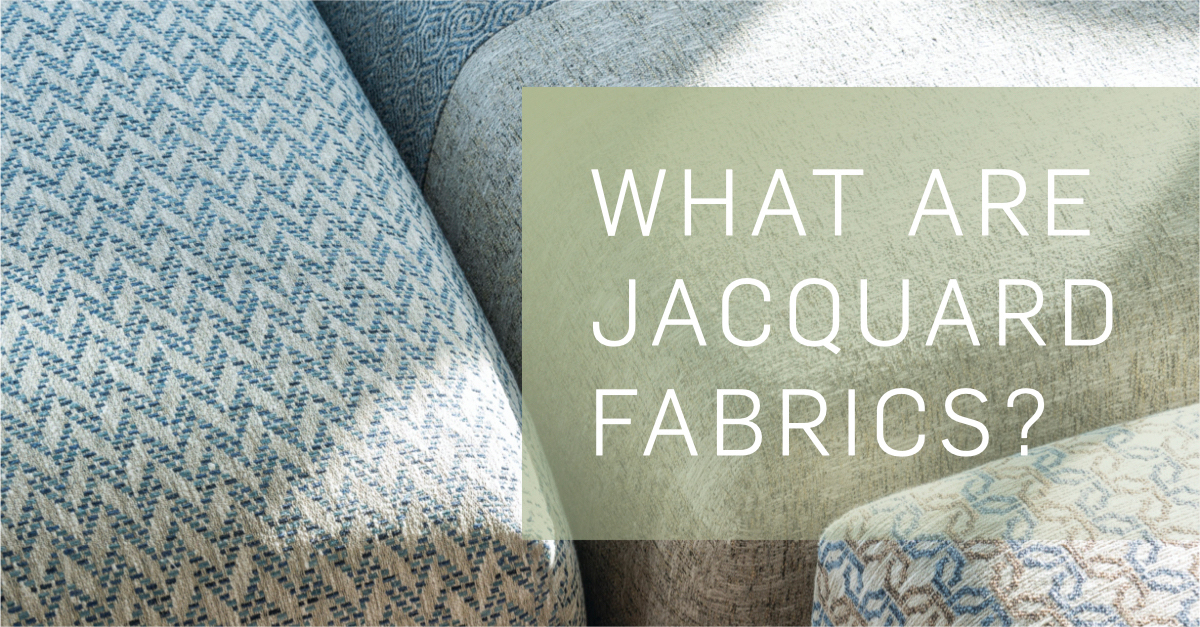
What is jacquard fabric? The definition
A jacquard fabric is a fabric whose pattern or design is woven directly into the construction of the cloth. It’s not printed, embroidered, or applied after the fact.
Our in-house production team puts it this way:
Jacquard is a type of woven fabric (or weave) where the pattern is woven into the cloth itself, not printed or embroidered on top. It’s made on a Jacquard loom, invented by Joseph Marie Jacquard in the early 1800s, which can lift individual warp yarns to create complex, often intricate designs (damasks, brocades, florals, geometrics, etc.).
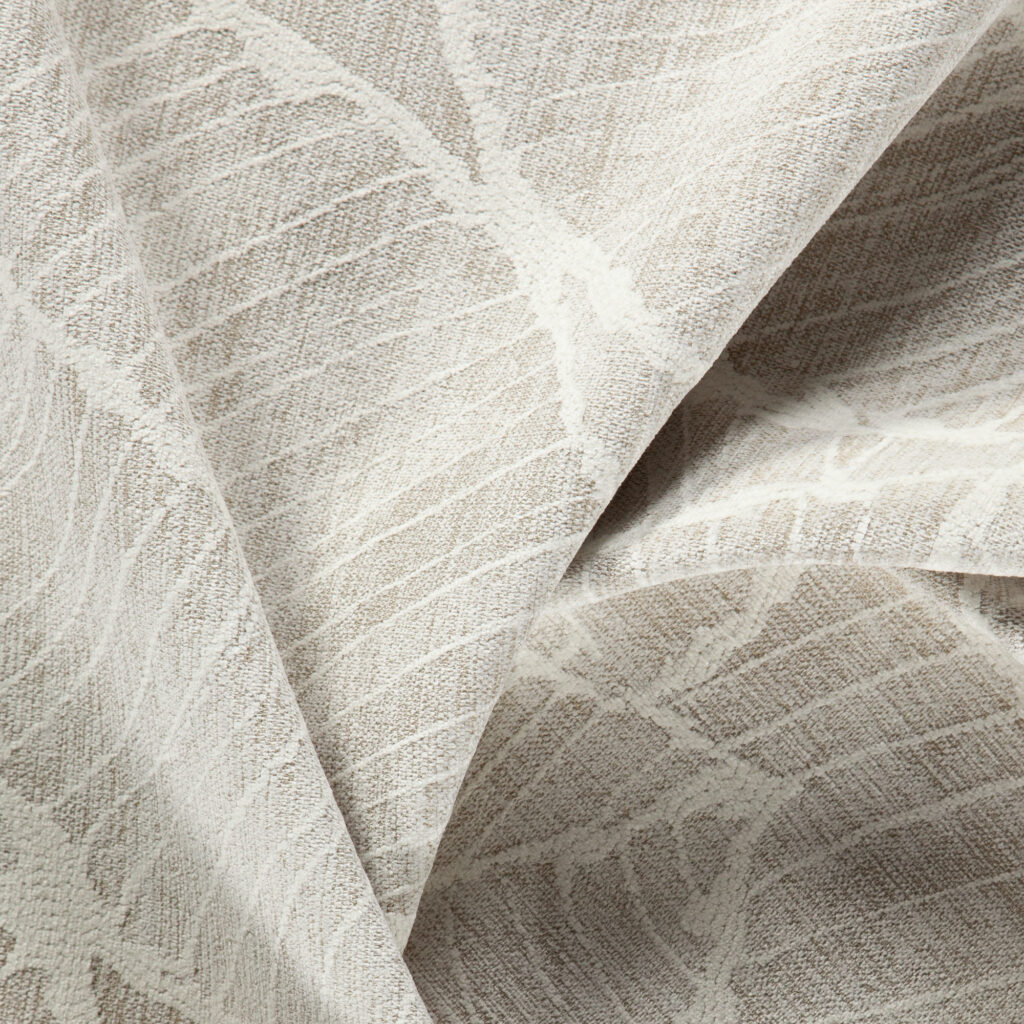
In a jacquard fabric, the pattern is the cloth. The arrangement of warp and weft yarns during weaving creates the design. This is why jacquard fabrics often have subtle relief and texture: different parts of the weave catch light differently.
The word "jacquard" doesn't refer to a fibre (it can be woven in wool, cotton, silk, polyester, or blends) or to a specific type of pattern. It refers to how the fabric is produced.
How does jacquard weaving work?
Jacquard is a weaving technique that uses a jacquard loom to control individual warp threads. This allows complex patterns and images to be woven directly into the fabric instead of being printed on the surface.
The Jacquard loom mechanism was originally driven by punched cards that “programmed” which warp threads should be lifted for each row, and modern computerised Jacquard looms use digital files to do the same thing, enabling detailed designs in fabrics like brocade, damask, and tapestry.
In a standard loom, all the warp threads in each section are controlled together, as opposed to a jacquard loom which allows for far greater detail and customisation.
This is what makes complex, repeating patterns possible.
The jacquard attachment: not actually a loom, but an addition to one
This is a point worth clarifying: the term "jacquard loom" is slightly misleading. The jacquard machine is not a loom in itself: it is a separate mechanism fitted to an existing loom. The combination of the loom and the jacquard attachment is what gets called a jacquard loom.
The history of jacquard fabric
Joseph-Marie Jacquard and the invention of 1804
The jacquard machine was invented by Joseph-Marie Jacquard, a French silk weaver from Lyon, who presented his design to Napoleon Bonaparte in 1804. Lyon was the centre of the European silk trade, and producing complex patterned silk cloth was extraordinarily labour-intensive work.
Before Jacquard, patterned weaving required a child positioned under or beside the loom (aka a 'draw boy') whose sole job was to manually lift the correct warp threads by hand, row by row, following the weaver's instructions.
Jacquard's machine automated this entirely. Patterns that had previously taken a team of workers days could now be produced by a single weaver operating alone.
Standing on other people's shoulders
Joseph Marie Jacquard’s invention was an integration of three primary 18th-century innovations:
- 1725 | Basile Bouchon: Introduced the perforated paper roll to automate thread selection.
- 1728 | Jean-Baptiste Falcon: Replaced the fragile paper roll with stiff punched cards for better durability.
- 1745 | Jacques Vaucanson: Applied mechanical refinements to the loom’s automation hardware.
Key Outcome: Jacquard integrated these disparate prototypes into a single, commercially viable attachment that revolutionized textile manufacturing.
The Jacquard loom: conflict and adoption
1. Social Resistance & Conflict
The loom was viewed as a disruptive technology, leading to significant labor unrest in Lyon:
- Motivation: Jacquard’s new loom was fiercely opposed by other silk weavers and draw boys in Lyon, because of its labour‑saving capabilities: they felt that technological unemployment loomed.
- Actions: It escalated to the point that several early machines were burned or destroyed, and some weavers even attacked Jacquard himself.
2. Governmental Intervention
To stabilise the industry, the French authorities implemented a unique legal framework:
- Public Property: The loom was declared the loom public property
- Patent Rights: The authorities granted the patent to the city of Lyon.
- Incentives: Jacquard himself received a lifelong pension and royalties per unit sold.
3. Rapid Market Adoption
Despite early opposition, the technology saw exponential growth:
| Year | Estimated Looms in Use | Location |
| 1812 | 11,000 | France (Total) |
| 1830s | 30,000+ | Lyon (Local) |
| 1830s | Tens of thousands | France (Total) |
Portrait of Jacquard inventor Joseph-Marie Jacquard. The original image was woven in silk on a Jacquard loom. - Textiles Gallery at the Science and Industry Museum.
Series of punch cards on the Jacquard hand loom in the Textiles Gallery at the Science and Industry Museum.
Jacquard's unexpected legacy
From silk to software
There is a famous woven portrait of Joseph-Marie Jacquard himself, rendered in silk in 1839 at such fine resolution that it was initially mistaken for an engraving. More than two metres tall, it required approximately 24,000 punched cards to produce. You can see it today at the Computer History Museum in California, USA.
The Computing Connection (1830s–1840s)
The transition from weaving patterns to calculating data occurred through two key figures:
- Charles Babbage: Adopted Jacquard’s punched card system for the Analytical Engine to input instructions and variables.
- Ada Lovelace: Conceptualized that if cards could represent silk patterns or numbers, they could represent any symbolic data (the birth of the "General Purpose" computer).
Industrial Legacy
This lineage runs directly from Jacquard's loom to Babbage's machine...and onwards from there to the punched card systems used in early IBM computers well into the 1970s:
| Era | Technology | Application |
| 1804 | Jacquard Loom | Automated Textile Weaving |
| 1840s | Analytical Engine | Theoretical General Computing |
| 1890s | Hollerith Tabulator | US Census Data Processing |
| 1960s-70s | IBM Mainframes | Early Enterprise Digital Computing |
It’s a truly remarkable chain of events: a labour-saving device invented to weave silk in Lyon became a key development in the foundation for modern computing.
Key kinds of jacquard fabrics
Historically silk‑only, jacquard is now a weave concept, not a fibre concept. It produces a wide family of fabrics, each with distinct characteristics. Here are the most common you'll encounter in modern upholstery today. Explore the key types of jacquard fabrics and their history and production in our Upholstery Fabrics guide.
- Damask upholstery fabric: from silk road workshops to eastern mediterranean royalty. Damask is probably the most recognised jacquard fabric.
- Brocade upholstery fabric: luxurious choices for elegant interiors. Historically silk with metallic threads from China, Italy, Byzantium, India, now also in cotton and synthetics.
- Matelassé upholstery: ‘quilted’ jacquard with a cloud-like feel
- Tapestry style jacquard upholstery: from wall art to furniture.
What “contemporary jacquard” means today
Modern jacquard production isn't limited to traditional ornamental styles – they're durable, dimensional fabrics produced in a wide range of styles and patterns, from minimalist geometrics to clean stripes to more funky textures.
Jacquard has mostly lost its association with formal rooms, appearing in casual, transitional and contemporary spaces, everywhere from dining rooms to living rooms to kitchen furniture.
Jacquard versus printed fabric: why it matters
When you're choosing upholstery fabric, the distinction between jacquard (woven-in pattern) and printed (surface-applied pattern) has practical consequences.
- Pattern durability. In a jacquard fabric, the pattern cannot wear, fade, or crack away from the surface because it is the surface. In a printed fabric, prolonged abrasion or UV exposure can cause the print to degrade, especially on high-contact areas like seat pads and armrests.
- Visual depth. A jacquard pattern has inherent texture and dimensionality because different weave structures reflect light differently. A printed pattern is flat. At a distance this may not matter; close up, and especially in tactile contexts, jacquard tends to look richer.
- Reversibility. Many jacquard fabrics, particularly damask, are reversible, with the inverse of the pattern visible on the back face. This isn't always useful in upholstery, but it is an indication of the structural complexity of the cloth.
- Design consistency. Because the pattern is woven rather than printed, there's no risk of the design misaligning with seams, pilling separately from the ground fabric, or transferring colour to other materials.
The trade-off is cost and design flexibility.
Printing is fast and allows for photographic detail, limitless colourways, and rapid production changes. Jacquard weaving is slower and more technically constrained, but as an upholstery fabric can stand up to years of use.
Jacquard upholstery: what to look for
Not all jacquard fabrics are equal, and the weaving technique alone doesn't guarantee long-lasting performance. Here's what matters when you're evaluating a jacquard for upholstery use.
Rub count (Martindale or Wyzenbeek)
Jacquard fabrics with float yarns (like brocade) can be more vulnerable to abrasion at those raised points. Check the rub count. Learn more: Abrasion Testing: Wyzenbeek & Martindale Compared.
Float length
In brocade-style jacquards, long ‘float yarns’ crossing the surface look luxurious but are vulnerable to snagging. Shorter floats are more robust for high-contact applications.
Fibre content and performance engineering
The fibre content of the yarn matters as much as the weave structure. A jacquard woven in 100% solution-dyed polyester will behave very differently from one in viscose or natural fibre blends. For performance applications (stain resistance, colour fastness, cleanability) the fibre choice and any finishing treatments are as important as the construction.
FibreGuard jacquard collections
FibreGuard jacquard upholstery fabrics are engineered to combine good looks and great staying power. These are high-performance fabrics that feature both the aesthetic depth of complex woven patterns alongside as well as the practical durability performance requirements of modern spaces.
- Stain resistance: FibreGuard jacquard fabrics have stain resistant properties woven into the fabric at the yarn level. This means cleaning a spillage from a jacquard fabric doesn't compromise the texture, sheen, or relief of the weave pattern the way surface-treated fabrics can.
- Colourfastness: FibreGuard jacquard fabrics are engineered for long-lasting colour integrity. The dyes are embedded deep within the fibres to ensure the pattern and tones stay vibrant, even after repeated cleaning or exposure to light, without fading or dulling over time.
- Durability: Built for everyday performance, FibreGuard jacquards combine strength and structure with softness. The woven construction helps resist pilling and abrasion, maintaining the fabric’s elegant texture and dimensional pattern through continuous use.
- Easy to Maintain: FibreGuard jacquards are designed with convenience in mind. Spills and stains can be cleaned with just water and mild soap, so regular upkeep is simple and doesn’t require specialist cleaning. Keeping our upholstery looking fresh and refined is just a straightforward process. Visit the How to Clean page for steps and tips.
➡️Browse FibreGuard jacquard upholstery fabrics ⤴️
Quick-reference glossary
Jacquard: A weaving technique using individually controlled warp threads to produce complex woven-in patterns. Also the name of the resulting family of fabrics.
Jacquard loom: A standard loom fitted with a jacquard attachment (the jacquard machine is a separate device, not the loom itself).
Warp: The threads running lengthways on a loom, held under tension.
Weft: The threads that pass horizontally over and under the warp to build up the cloth.
Damask: A reversible jacquard fabric with contrasting weave-direction patterns, typically matt on lustrous or vice versa.
Brocade: A jacquard fabric with raised, three-dimensional figures created by yarn floats on the surface.
Tapestry: A dense, multi-coloured jacquard fabric with high abrasion resistance and a matt finish.
Matelassé: A double-cloth jacquard with a raised, quilted-effect surface.
Float yarn: A yarn that passes over multiple threads without interlacing, creating surface texture; longer floats are more vulnerable to snagging.
 Clean & Cosy Homes
 Healthcare